Tuesday, September 7, 2010

Spotlight on Sinergia's Metropolitan Parent Center

Sinergia's Metropolitan Parent Center (MPC) is a federally funded Parent Training Information Center (PTIC) whose mission is to empower parents of children with disabilities by providing them with knowledge and skills. Our aim is to provide them with information and training and connect them with specific educational services and opportunities that will enhance their child's quality of life.

In February we relocated to a new facility at 2082 Lexington Avenue, near 125th Street, which is at the crossroads of the communities we serve: East Harlem, Central Harlem and the Bronx. In this new location we provide one-on-one assistance and advocacy to parents experiencing difficulties with their child's education. Our staff is bilingual (English/Spanish) which is important because a large percentage of our consumers have limited or no English language skills.

We help families in low-income areas who are traditionally under-served or unserved. They are often the most disenfranchised and face many barriers to service. With our help they are able to receive information, navigate the system and secure the most appropriate services for their children.

We cover the full range of disabilities from moderately to severely disabled, from birth to 26 years of age. Read about a recent success story we had in getting the best care for one of our consumers.

The MPC Team


Co-Director                        Co-Director
Godfrey Rivera                    Cassandra Archie

Educational Advocates
Lizabeth Pardo                     Yesenia Estrella

Facilitator of Parent Support Group
William Bird Forteza

____________________________

Meet the Education Advocates

Yesenia Estrella
"Helping others has brought a great deal of satisfaction to my life.Three and a half years ago when I started working at Sinergia as a Service Coordinator, I discovered a world that was completely unfamiliar to me, the world of children with special needs and their families. I quickly decided that I wanted to learn more about special education and started taking training workshops that were offered through our agency. During these trainings I got to know parents by listening to their stories.  I quickly noticed that most of them shared similar challenges and feelings of frustration by having to struggle to constantly obtain adequate services for their children.  My first thought was 'I have to do something to help.'

I tried to learn as much as possible about disabilities and about the skills needed to effectively advocate on behalf of parents and their children.

The Metropolitan Parent Center has given me the opportunity to work with many parents that were having difficulties obtaining a free and appropriate public education (FAPE).

When looking for an educational advocate, parents should look for someone who is committed, knowledgeable and who has good negotiation and mediation skills."

Lizabeth Pardo
"Being an advocate allows me to work in the field of education, which I feel very strongly about.  I come from parents with little formal schooling but who placed a lot of importance on an education. As a law student, I studied about the right to an education; I took two independent classes because I believed that by having knowledge, issues of poverty could be overcome.

That was ten years ago, and my experience with my son in public school and my work at Sinergia have deepened my convictions. Although that is the background I bring, it is certainly not at the forefront of my mind when meeting with a family about their child's educational needs.  For people with disabilities, access to an education is a right that must often be fought for. I enjoy the many levels that my work involves when working with families individually, both within the New York City school system, and in collaboration with community organizations."
____________________________

The Ethics of Advocacy

At Sinergia we practice the role of advocacy with a focus on ethics that ensures the work we do with and on behalf of families and children with disabilities is being delivered with the highest standards. Our advocates must:

    * Ensure the limits of their role are clearly defined
    * Offer honest information and opinions
    * Point out weaknesses and strengths
    * Identify provisions of the law
    * Inform parents of their basic rights
    * Assist parents in obtaining consultation or services from a licensed attorney if necessary
    * Abide by the decision of the parent
    * Use his/her best effort to achieve the goal(s) of the parent
    * Conduct advocacy in a civil and professional manner
    * Maintain confidentiality
    * Work with the family until issues are resolved

____________________________

What Parents and Professionals Are Saying About the MPC


"From the bottom of our hearts, thank you for your time and dedication, advice and work. May God always bless and protect you. With enormous affection..."

"(Sinergia's) work ethics are outstanding. I have never worked with an advocate agency so efficient and competent before, and believe me I have worked with quite a few".

"I always talk to my friends about Sinergia and I recommend it. A friend of mine is also receiving services now and I know she is very happy with the help she is getting."

"Special thanks to Yesenia Estrella. She always helps me. Any time.  She is a wonderful person. Thank you"

Choosing a Special Education Program for Children with Disabilities

When it comes to education for children with disabilities, there's no "one size fits all." Parents need to look along a continuum of programs provided by the New York City Department of Education to see which ones fit the individual needs of their child best. Once the appropriate program has been selected parents must monitor their child's progress so that if they need to they can transfer him or her to one that ensures educational benefit. That way their child is not locked in an inappropriate setting throughout their years in school.

Which program is right for your child is guided by the least restrictive environment mandate which requires that students be educated with typically developing peers to the maximum extent appropriate. This is important because, as our U.S. Congress discovered, education is more effective when the learning environment has higher expectations of its students. 

The programs below are described generally and may be different in your school. The continuum of services listed here are from less restrictive to more restrictive.

From Least to More Restrictive
General Education with SETTS: the student is generally enrolled in their zoned school and attends a general education class. A special education teacher or SETTS provider generally pulls out a student in a small group. The group can be as many as 8 students who share similar academic needs. SETTS services may also be given in the classroom as well. 

Collaborative Team Teaching (or Integrated Co-Teaching): is classroom taught by two classroom teachers, one special education and one general education. Students with IEPs are integrated into a classroom of non-disabled students and taught a curriculum that is at grade level. The number of students with IEPs should be less than half the classroom.

12:1 program in a community school: this is a small class, 12 students, in a community school, typically the students have a learning disability and are without disruptive behavior. There may be as many as many as three grade levels in a classroom. Many schools do not have this program and so accepting this program may mean a change of schools. Community schools should be located close to the family's home. This program is offered only in elementary and middle schools.

12:1:1 program in a community school: This class differs from the 12:1 program in that students require the additional supervision of a classroom paraprofessional. The disability of the students is more varied but academically the students must be functioning within 3 grade levels of one another.

15:1 program in a community school: This is a program similar to the 12:1 program but for high school students.

Specialized School or District 75 programs are city-wide programs that services students with disabilities whose needs cannot be met in a community school. Students may reside anywhere within the City but usually live within the same borough. The programs are 12:1:1, 8:1:1, 6:1:1 and 12:1:4, with smaller classroom servicing students with more educational needs. Most of the programs are for students with developmental disabilities, although there are also programs for students with difficult behavioral management needs. The 6:1:1 programs normally serve students with autism and the 12:1:4 serve students with multiple disabilities.

Programs considered more restrictive are approved non-public schools, day treatment programs, residential placements, and home or hospital instruction.

Here's more information about these and other special education services.


(photo: http://www.sxc.hu/profile/cienpies)

Friday, September 3, 2010

Understanding "Related Services" for Children with Disabilities

Related services are fundamental to meet the educational needs of children with disabilities.  They are developed to offer students with disabilities specialized assistance in areas such as speech and language therapies, physical therapies, occupational therapies, counseling, hearing services, mobility services and health services.  


Typically, personnel from the Department of Education (DOE) provide these services while the child is in school. However, this is not always possible and a lot of students end up receiving the services elsewhere. The most common reason for this is when schools run out of providers. When this happens, the DOE looks into associated or contracted agencies in order to offer the services within the school. If they are not able to find any, parents should receive a Related Services Authorization (RSA) letter, which allows them to find an independent provider paid by the DOE.

Parents should contact the schools as early as possible during the semester to find out if their children are receiving the mandated related services.  They should also know that these services are only mandated if they are written on the child’s Individualized Education Program, or IEP. 

If a child is missing some or all of his or her related services, parents need to contact the district office and request RSA letters. The DOE also provides transportation reimbursement to and from the therapist office, and some therapists are able to travel to the child's home to provide the services. 

When obtaining RSA letters, parents should also receive the list of independent providers with their contact information. Here's a list of related services providers by borough.

MPC: Real Stories From Real Parents

Transfer to District 75 Stopped Using Mediation

Daniel was an 8th grade student in a 12:1:1 program in a community school when his parents contacted Sinergia's Metropolitan Parent Center (MPC). They needed our help because their son was being recommended for a more restrictive 8:1:1 program in District 75 with a classification of emotional disturbance (ED).  The parents did not know 8:1:1 programs are intended to serve students with autism, but were told that the smaller class would provide Daniel with more assistance.

Daniel’s parents, now represented by the MPC, rejected both the program recommendation and the classification of ED. However, soo after that Daniel was suspended by the school, in what looked like retaliation. Undeterred, the parents requested a Functional Behavior Assessment (FBA), which they had learned was a document required by law before an Individualized Education Plan (IEP) team can consider a more restrictive placement for behavioral reasons. As previous meetings had been very heated, and the FBA and Behavior Plan would halt any school transfer, getting the school to support Daniel in his current program was going to be a challenge.

The MPC suggested the parents consider mediation as a voluntary dispute resolution process and after some convincing both parties agreed to it. Although not a smooth process, mediation allowed both parties to express their concerns and resulted in a redirection of efforts from pushing Daniel from his current school to providing him with the support and services he needed. He received counseling from a school psychologist with whom Daniel was able to develop a trusting relationship with, and was also assisted by his tireless, dedicated teacher. Within months progress was evident. Today Daniel is in a high school for the arts and is doing fantastic work!

A New Beginning for Tania and her Son

As a precursor to the Puertorican Day Parade, the 116th Street Fair on Saturday, June 12, 2010 was a feast of food, music and very colorful characters. Sinergia participated in the fun and fanfare thanks to a booth donated by Mt. Sinai Hospital. Our staff members were on hand all day long to answer questions and distribute brochures. We offered free blood pressure screenings in the morning which had a huge response, and during the "afternoon shift," Michael Mitchell, Tiffany James, Carmina Perez, Mildred Ramos and Lizette Dunn-Barcelona greeted people walking by to give them information about Sinergia's many services.

A young woman by the name of Tania, her disabled 9 year old son and her cousin were among those that stopped by. The mother and son had just arrived from Puerto Rico within the last two weeks and were staying with their cousin in the Bronx. Tania's son had had several surgeries in Puerto Rico and she was now trying to get special care for him in New York City. She was in need of medical and educational services for her son, and a place to live.

The following Monday Sinergia began working with Tania and within two weeks she and her son were living in one of Sinergia's Tier ll shelters funded by the Department of Homeless Services. She also began receiving case management services through our Family Support Program. Their case manager will ensure that her son's Medicaid services are in place, that all his evaluations are current and that he is enrolled in a district 75 school in time to begin classes this fall.

Both Tania and her son are doing well and are adjusting to life in NYC. Once her son is settled in school Tania hopes to begin looking for work in order to find permanent housing. She is grateful to Sinergia and looks forward to a long rewarding relationship with us.

Tuesday, August 24, 2010

Sinergia Intern Carries the Message to the Dominican Republic

For two summers in a row we have had a guest intern, Kirsy Rosado from the Dominican Republic who is from La Asociacion Dominicana de Rehabilitacion. The organization has four schools that focus on special education and rehabilitation.  Unfortunately according to Kirsy they do not have much in the way of parent training. Last year she was exposed to many programs at Sinergia and of course the workshops and the work of our Parent Training and Information Center, which she enjoyed immensely. Her internship is sponsored by an organization called DONAR America which provides technical assistance to organizations in the Dominican Republic and NYC, primarily to the Dominican population.

The PACER Center has graciously agreed to share the Spanish translation of their FAST curriculum, which is focused on the development of training modules to teach families and their children to become self-advocates. Kirsy is a wonderful teacher and administrator and we are very pleased that she is bringing this much needed training to people with disabilities in her home country.

Monday, August 23, 2010

Recap of July Events at Sinergia


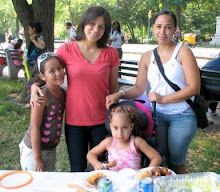
On Friday, July 9th Sinergia held its Annual Family Picnic in Central Park.  Thanks to the assistance and hard work of the staff this picnic turned out to be just as successful as the ones we have had in the past.  Again this year we featured games, gift bags, balloons and prizes for the young kids as well as music, food and good times for the adults.  The weather was perfect (well maybe a little hot) but the estimated 250+ guests that the staff entertained all seemed to have a great time.  Thanks to our friends at Chem-Rx for their generous donation that once again made the picnic possible.  See you all next summer!


 On Thursday July 29, 2010, Sinergia celebrated the dedication, hard work and passion of its Family Care providers with an Appreciation
Luncheon
. Family Care Coordinator, Kenia Peralta and her team organized a fabulous luncheon and also presented each coordinator with flowers and a framed certificate of appreciation.  Sinergia Executive Director, Myrta Cuadra-Lash attended the luncheon and personally thanked these long-term providers for their invaluable contribution to the lives of the people with disabilities in their care.  These providers open their homes to these individuals with disabilities and treat them like a member of the family.  Many of them have had the same person in their care for more than ten years and in one case, over twenty. The Family Care program is a very unique service provision and the kind of dedication that is required cannot be taught or paid for. We thank the following providers for their continued service:
 
Regular providers:
ANA GUZMAN
ANGELA BAEZ
GUADALUPE GUILLEN
CARMEN ULLOA
LEYDI DOMINGUEZ

Substitute providers:
ADRIANA POLANCO
SIRIACA BAUTISTA