Showing posts with label special education. Show all posts

Saturday, February 2, 2013

Protect Access to Early Intervention Services

As part of the Individuals with Disabilities Education Act (IDEA), the Early Intervention (EI) program provides evaluations and services to infants and toddlers who have developmental delays or disabilities and their families. Early Intervention is cost effective and helps infants and toddlers at the time when services can make the biggest difference.

Governor Cuomo’s 2013-2014 Executive Budget proposal would restructure Early Intervention, linking EI services with health insurance coverage. The budget proposal would:
  • Allow a health insurance representative to be part of the team that develops and reviews a child’s Individualized Family Services Plan (IFSP), giving the health insurance company a voice in determining a child’s EI services for the first time.
  • Require EI providers to join health insurance networks, negotiate their reimbursement rates with health insurers, and exhaust all appeals of claim denials by health insurers before being paid by EI, likely leading to a further reduction in the number of experienced EI providers available to serve children.
  • Require children to be evaluated and served by evaluators and service providers within the children’s health insurance network, without a clear process for obtaining an exception for children who need specialized service providers. 
For more information contact Randi Levine at RLevine@advocatesforchildren.org

Thursday, October 4, 2012

The NYC Department of Education’s Special Education Reform


The NYC Department of Education (DOE) has engaged a far-reaching special education reform effort. The stated goals of this Reform are to “improve access to more challenging academic curricula and to achieve better outcomes for students with disabilities.” This will be carried out by providing significantly more students with disabilities the opportunity to attend the schools they would attend if they did not have Individualized Education Programs (IEPs). 

The Reform is intended to provide more students with disabilities access to their zoned schools and other schools of choice. Most NYC public schools will be expected to meet the needs of the majority of their students with IEPs. During the current school year, parents of students entering: kindergarten, middle school (6th grade), high school (9th grade) and “over-the-counter” students (those new to NYC’s public schools) with special education needs may be asked to consider different service and placement recommendations than in the past. The DOE is asking schools to reexamine students’ IEPs based on the availability of the program or service in the school building and the least restrictive environment. Your child’s school may ask you to reopen your child’s IEP even if you recently agreed to a new IEP at an annual review or this is your child’s first special education placement.

Unless your child has been accepted into a special program, such as Autism Spectrum Disorders (ASD) Nest or District 75, or requires bilingual services or a barrier-free site, you will not have the option of having your child attend another school that has the program or service on your child’s IEP. Other exceptions may apply to reasons pertaining to health and safety issues. Remember that parental rights in special education result from federal and state law. The Reform is a local policy matter and it does nothing to change your legal rights as a parent. Your child has the right to type of class and services on his/her IEP regardless of whether or not the school currently has them. The DOE is promoting the move of students with IEPs into the general education classroom (with the necessary supports and services.) However, there are questions whether general education teachers have received sufficient training in working with students with special needs.

If you are still having trouble resolving the matter, call 311 and ask to speak with the DOE’s Special Education Call Center. You may also try calling the DOE’s Hotline (718-935-2007) or visiting one of their locations for Special Education Family Office hours. In addition, the DOE has set up Special Education Family Office Hours which will run through September 27, 2012 and a hotline (311) or (718) 935-2007) for parents to help resolve concerns related to the reform.  For details on office hours, click here.

Your child has the right to receive the type of class and services on his/her IEP regardless of whether or not the school currently has them. Your child is still entitled to receive a free, appropriate education in the least restrictive environment, according to the federal law, The Individuals with Disabilities Education Act. (Photo)

Monday, September 10, 2012

Back to School Resources from the NYC Council

Below is helpful information for families preparing and planning ahead for the new school year, from the NYC Council.

Implementation of the Dignity for all Students Act
The Dignity Act, which went into effect on July 1, 2012, increases the requirements for schools in preventing bullying and creating harassment-free learning environments. (Click here for information on the law's requirements within our schools.)

Here are some things to keep in mind as your child returns to school this year:

• Schools should send home an age-appropriate version of the Dignity Act policy with all students.  This should be in plain language and should be distributed at the beginning of the year.
• Every school should have a Dignity Act coordinator, an individual who is currently called the Respect for All (RFA) liaison.  This individual must be thoroughly trained to respond to incidents of bullying and bias-based harassment that occur as a result of students' race, color, weight, national origin, ethnic group, religion, religious practice, disability, sexual orientation, gender and sex.
• School staff (non-professional staff) should be trained to raise their awareness and sensitivity to potential discrimination or harassment, as well as how to prevent and respond to a bullying incident.
• School staff who find out about harassment or bullying are required to act immediately to report and address bullying.  They should be trained in the proper procedures for doing so.
• School staff must be aware that the Dignity Act now encompasses staff-to-student bullying, and has the same reporting requirements as student to student bullying.
• Schools must answer all bullying incidents with specific responses intended to create a school environment that is free from discrimination and harassment.

If you have any questions about whether or not your child's school is abiding by these regulations, you can contact the DOE at RespectForAll@schools.nyc.gov.  You can also contact Carlos Menchaca or Nick Rolf in the Council's Community Outreach Unit at cmenchaca@council.nyc.gov and Nrolf@council.nyc.gov, respectively.

New Special Education Services for Students and Families

The following services are being offered to help families get their questions answered in a timely manner.

Beginning August 1, 2012, families who need assistance with their children's placements or have any questions regarding the reforms can do any of the following:

1. Call a dedicated hotline for special education support at (718) 935-2007;
2. Call 311 and ask for services for parents;
3. Attend family office hours in nine sites across the five boroughs with day, evening, and weekend hours beginning July 31, 2012.  During office hours, a special education specialist will be available to help resolve families' questions about the special education reform initiative and work to reach solutions to support their child(ren).  The complete schedule of dates, times and locations is available on the DOE's website at http://schools.nyc.gov/Academics/SpecialEducation/when-is-the-next/2012parent-information-session.htm.

Free Citywide Legal Services for Immigrants & their Families

Last week the NYC Council announced a new partnership with CUNY Citizenship Now! to begin providing free high-quality and confidential legal immigration services to New Yorkers and their families in the wake of President Obama's historic decision to defer deportation action for young immigrants.  These services, which begin October 1, 2012, will be offered at 30 different locations on a weekly or monthly basis over the next year.

Through this Council-funded program, qualified attorneys and paralegals will offer one-on-one consultations and assist qualified immigrants with applying for citizenship.  New Yorkers will have access to a variety of legal services, including green card applications, deferred action, citizenship interview coaching and more.

Services will be offered weekly at seven Council members' offices in Queens, five in Brooklyn, four in the Bronx, three in Manhattan and one in Staten Island, and offered monthly at three offices in Queens, four in Brooklyn, two in the Bronx, one in Manhattan, one in Staten Island.  Locations were selected by analyzing Citizenship Now! data from years past.

You can find the full list of participating Council Member offices here.

Changes Made to School Discipline Code

Missing even a few days of school, especially during those critical early years (kindergarten through 3rd), can have negative consequences throughout a student's academic career.

After several public hearings and a meeting with the Speaker's office, the NYC Department of Education (DOE) recently updated their discipline code, which includes a number of important changes that the City Council and advocates called for. 

These changes include:

• Previously, a Level 3 Infraction (defined as disruptive behavior) could result in a "superintendent's suspension" (an out of school suspension lasting 6-10 days).  This is no longer an option for students in grades K-3.  The maximum penalty for the same infraction would result in a "principal's suspension" (less than 5 days).

• The DOE has also changed language in the code to encourage teachers to start with guidance-based intervention rather than immediate discipline.  For example, instead of suspending a student, teachers will be encouraged to hold a conference with the child, their parents, and a social worker to explain why the student's actions were wrong and to collaboratively develop a plan to help that student improve their behavior in the future.

You can find the DOE's revised discipline code, effective September 2012, here.

You can read more about these important changes in the news by clicking on the links below:

http://gothamschools.org/2012/08/28/disciplinary-code-revisions-could-reduce-student-suspensions/
http://www.schoolbook.org/2012/08/28/softer-suspension-rules-for-younger-students/

Get Your Library Card!

There are over 200 libraries in neighborhoods around the five boroughs that offer millions of books, resources, and internet access free of charge, and the back-to-school season is a perfect time to become a library card holder.

By becoming regular visitors to the library, young people can further their academic and work skills and become lifetime learners.

Information about applying for a library card is available at http://www.nyc.gov/html/dycd/downloads/pdf/Get_a_Library_Card_Guide.pdf.

Please help spread the word and encourage young people to apply!

New GED Test for 2014

Beginning January 1, 2014, there will be a new GED test in New York State.  As a result, any scores on the sections passed by test takers prior to that date will no longer count.  Therefore, we encourage anyone who's considering taking the GED again to do so by the end of 2013.

There are a number of programs around the City that can help students and adult learners prepare for and pass the GED.  For example, New York City has a network of Literacy Zones with counselors who can assist New Yorkers with finding a GED preparation program that best serves their needs.  Please call or visit one of the organizations below for more information:

Brooklyn

Turning Point
5220 Fourth Avenue, Brooklyn, NY 11220
718-360-8180/8159

The Bronx

Highbridge Community Life Center
979 Ogden Avenue, Bronx, NY 10452
646-393-9533 X117

Manhattan

CUNY Borough of Manhattan Community College
199 Chambers Street, S-736, NY, NY 10004
212-346-8890

Literacy Partners, Inc.
PUSH Family Welcome Center
127 West 127th St, NY, NY 10027
646-351-0258

Northern Manhattan Improvement Corp.
76 Wadsworth Avenue, NY, NY 10033
212-822-8323

University Settlement Society of New York Inc.
184 Eldridge Street, NY, NY 10002
212-533-6306

Queens

CUNY York College
94-43 160th Street, Jamaica, NY 11451
718-262-3861

Ravenswood Family Learning Center
35-32 21st Street, Long Island City, NY 11101
718-752--3718

Peninsula Adult Learning Center
92-25 Rockaway Beach Blvd., Rockaway Beach, NY 11693
718-945-7058

Staten Island

Jewish Community Center of Staten Island
1859 Victory Blvd., Staten Island, NY 10314
718-508-3882

YouCanToo! is another great resource.  Their website features a GED prep program locator, online tools, resources and over 50 videos of adult learners in New York City.  For more information, log on to www.nyc.gov/youcantoonyc.

You can also call 311 to find an adult education program in your community.

Universal Pre-Kindergarten (UPK)

Early childhood education has benefits across a child's lifetime, including raising academic achievement and increasing the chances that a child will successfully graduate from high school.

As in previous years, the NYC Council is partnering with the NYC Department of Education (DOE), the NYC Administration for Children's Services (ACS) and child care advocates across the five boroughs to help enroll children in FREE universal pre-kindergarten (UPK).  These programs are available to all children who turn four year old in 2012 and regardless of their immigration status.

There are a few ways that families can get information about the nearest UPK program with available seats:

1. Call: 311
2. Visit: www.nyc.gov
3. Text: prek to 877877

Every student deserves a great education and that every family should have the information that they need to make sure that their children are in a positive, supportive, and healthy learning environment.

Thursday, September 1, 2011

Sinergia's Back to School Open House


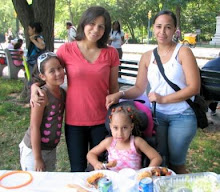
Sinergia held a Back to School Open House on September 1, 2011 and it's hard to capture with words how exceptional the families that attended were. We put together this special event for parents of children with disabilities to help them prepare for the fall semester, and over 100 showed up, some of them from as far as Brooklyn and Queens. Several parents brought their severely disabled children in wheelchairs along with their other children in tow. One mother who lives in a shelter came with a severely disabled child who was on a feeding tube. It was very moving to see how committed these parents are to giving their children a better life, to learning and to connecting with other families. It also speaks to the trust they have to Sinergia.

We screened a video on the 35th Anniversary of the Individuals with Disabilities Act (IDEA) followed by a presentation on education advocacy by Cassandra Archie, co-director of the Metropolitan Parent Center (above, front left). There were also presentations by representatives of the many programs found at Sinergia, including housing assistance, residential services, respite, reimbursement services, We Are Parents Too (a program that offers parenting and other skills for parents with developmental disabilities) and the Day Habilitation and family support services. The parents had the opportunity to meet the different coordinators of programs, ask questions and receive information not only about our programs and services but education in general.


We held a raffle and seven lucky parents won backpacks fully loaded with school supplies and gift certificates to Footlocker, which will come in handy at the start of the school year. Pizza and refreshments rounded out the day. Children delighted in playing with computers in the special activity areas while the parents acquired valuable information.


Our Metropolitan Parent Center worked together with various other departments to make this a resounding success. To view the full album visit our Facebook page.

Sunday, August 28, 2011

Back to School: Special Dates in September

As the new school year gets underway,  here are some special dates parents need to take note of in the month of September (from the NYC 2011-2012 School Year Calendar):

September 5, Monday
Labor Day (schools closed)

September 6, Tuesday
Classroom Teachers, Bilingual Teachers in School and Community Relations, Guidance Counselors, Attendance Teachers, Nurses, Therapists, Laboratory Specialists and Technicians, Educational Paraprofessionals (except for School Secretaries, Psychologists and Social Workers) report for work. School Secretaries, Psychologists and Social Workers report for a regular work day.

September 7, Wednesday
SCHOOL SESSIONS BEGIN FOR ALL STUDENTS
Early dismissal for non-District 75 Kindergarten Students only. Partial school time for Prekindergarten public school students.

September 8, Thursday
Early dismissal for non-District 75 Kindergarten Students only. Partial school time for Prekindergarten public school students.

September 9, Friday
First Full day for non-District 75 Kindergarten public school students. Partial school time for Prekindergarten public school students.

September 12, Monday
First Full day for all Prekindergarten public school students.

September 29-30, Thursday and Friday
Rosh Hashanah (schools closed).

(photo)

Busing Issues for Special Needs Children

The Office of Pupil Transportation (OPT) announced that on September 8, the first day of the school year, yellow school buses will take 150,000 children to their schools and back home. For children with special needs who will be transported in a mini-van, parents can expect a letter confirming the bus route and pick-up time by August 29th.

OPT has come under fire in recent years because of budget-cutting measures that affected many of the city’s children. Students from multiple schools now share the same bus, bus routes were consolidated and lengthened, and students with special needs were required to provide medical documentation to qualify for a seat in a mini-van. There have been on-going transportation problems with the 60,000 special needs children who ride the smaller mini-van and have often suffered from inferior service, according to Maggie Moroff, special education policy coordinator at Advocates for Children. “In past years we have heard from too many families about children not picked up at all and missing hours, sometimes days, and sometimes more, of critical school time,” she said. In addition, students with limited travel time requirements have been on the bus for way too long. OPT responded that it promises to do better and added that “we are making a big effort to communicate with parents about how the OPT system works, what they should do when there’s a problem and what documentation, including medical documentation, is needed to match the right bus service to each child.”

For more read "DOE answers parents' busing questions."

Do you have a child that needs to travel on the mini-vans? What problems have you encountered with OPT? What suggestions do you have to ensure that children have a safe and speedy trip to school and back home? We would love to hear your comments.


Photo source

Friday, August 12, 2011

Special Ed Checklist


Here are three things that are crucial for parents to do in the first 30 days of school -- if they're not in place there could be bad consequences later in the semester!    
  1. Your child's Individualized Education Program (IEP) must be in place the first day of school.
  2. Devise a system to monitor your child's progress towards their IEP goals so that you review it at least as often as you receive progress reports or report cards.
  3. Determine whether your child's special education teacher is highly qualified (HQ). All special education teachers must be HQ in special education, which means they must be "certified." In addition, some special education teachers must also be HQ in the subject(s) they teach.
(photo)

Sinergia's Back to School Open House

back to school
The annual back to school rush starts in earnest this month, so we wanted to focus our August newsletter on helping parents of children with disabilities to get ready. 


This is the time of year when parents are usually running all over town stocking up on backpacks, supplies and other essential items their kids will need for the fall semester. But if your son or daughter has special needs, there are some additional things you need to add to your list. To help parents get prepared, Sinergia will be hosting a Back to School Open House on Thursday, Sept. 1st from 11am to 1pm. We will have program coordinators present that day giving brief introductions about their programs, and parents will be able to: 

  • Meet our Educational Advocates and Educational Attorney
  • Get educational information
  • Have an opportunity to ask questions
  • Learn about Sinergia programs
  • Tour our beautiful office space
  • Enjoy a light lunch   

At the Open House we will unveil the beautiful quilt that was a project of the "We are Parents Too" program. Under the leadership of staff member Maria Torres Bird, parents with developmental disabilities worked on the quilt and sewed individual patches with tributes depicting the love they feel for their children. We will also be raffling two gift certificates, $50.00 each, from Footlocker. You must be present to win. For more information call 212-643-2840 ext. 307.       

Here's a useful web page you might want to keep handy to keep track of all the special dates you'll need to know: 2011-2012 School Year Calendar.                                                           (photo: www.lifehack.org)

Friday, July 29, 2011

How Well Do You Know Your Child's School Staff?


Situations arise all the time at school and often you may be unsure of who to call -- should you speak to the principal or your child's counselor? By getting to know the staff at school you'll also be better prepared for IEP meetings. It's about understanding how the school operates, and knowing what role the different people play in supporting your child. Here's a list that will help you gather all the pertinent contacts you'll need. Keep it handy and update it as needed.


1.    My child’s school principal name is ___________________________________________

2.    The name of the assistant principal is_________________________________________

3.    The school counselor name is _______________________________________________

4.    My child’s Special Education teacher’s name is_________________________________

5.    My child’s general education teacher’s name is_________________________________

6.    What is the name of the school Psychologist___________________________________

7.    The Parent Coordinator is__________________________________________________

8.    The name of the school secretary is__________________________________________

9.     I have the telephone numbers of each of the above    Yes                              No

10.    I know where they are located at the school?               Yes                             No

(photo: www.school-portal.co.uk)

Making The Most of the Parent Teacher Conference


You and your child’s school have something in common: both of you want your child to learn and do well. Parent Teacher Conferences are an important component of the ongoing dialogue between families and schools, so when talking with your child’s teacher, remember that both of you have valuable information to share, and both of you can learn something new to help your child. The Parent Teacher Conference is a two-way conversation and good outcomes are achieved when both parents and teachers talk and listen. There should be an emphasis on learning and a focus on both how well the child is doing in school, as well as how your child can do better. Opportunities and challenges should also be discussed.

Parent Teacher Conferences typically occur before a child's first marking period, when they receive their report cards. That means the first one will happen just before Thanksgiving, but parents do not have to wait until then. They can ask teachers for a conference at any time. They can also make the request in writing, if they wish to document it.

Cassandra Archie, Co-Director of the Metropolitan Parent Center suggests that the first Parent Teacher Conference be scheduled at the end of September, and below are some questions that parents should ask teachers to understand if their child is starting out properly.

Talk to your child’s teacher about:
  • Progress – how is your child doing.  Is my child performing at grade level? What do you see as his/her strengths?  How could he or she improve?
  • Assignments and assessments. Ask to see examples of your child’s work. Ask how the teacher gives grades.
  • Your thoughts about your child. Tell the teacher what your child is good at. Explain what your child needs.
  • Support learning at home. Ask what you can do at home to support your child’s learning.
  • Support learning at school. Ask how the teacher will both challenge and support your child when they need it.
After the parent teacher conference, Ms. Archie has some additional recommendations:
  • Make a plan  - Write down the things you and your teacher will each do to support your child.  Make plans to check in with the teacher in the coming months.
  • Schedule another time talk – There are many ways to communicate, in-person, by phone, notes, email. Be sure to schedule a time to talk.
  • Talk to your child.  If appropriate talk with your child, don’t forget to include him or her.

For more info visit The Harvard Family Research Project – Parent Teacher Conferences: A Tip Sheet for Parents www.hfp.org

Does The School Fit My Child’s Needs?

According to Cassandra Archie, co-director of Sinergia's Metropolitan Parent Center, it's important for parents of children with special needs to think critically about whether the school fits with their child's needs. To that end, she compiled a checklist of questions to help them make an ongoing assessment. It can be used throughout the year, but she says parents should know and understand some of these items immediately, like in the first month -- for example, regarding philosophy and behavior issues.

Checklist
  • What is my child’s school philosophy?
  • How is the school guided by that philosophy?
  • How long has the principal been at my child’s school?
  • Does the principal have any teaching experience?
  • What training does a teacher receive for a particular class they are teaching?
  • What types of opportunities are there for integration with non-disabled students?
  • Are there any after-school programs offered? If yes, which ones?
  • How does the school address behavior issues?
As the school year progresses, if it happens that parents need to seek another school, or the district has given them permission and supplied them with a list of alternatives, here's a post we wrote on Changing Schools.
(photo: thedailygreen.com)

The New IEP Forms Are Here – Are You Ready?

On Sept. 1st during our Back to School Open House we will have a 20-minute session giving hands-on instruction on getting familiar with the new IEP system. Parents will be able to familiarize themselves with the new IEP forms, which were developed by the State to help IEP teams focus on the services that are most important and to reduce variation of forms across the state. Here's what you'll need to know: 
  • The new IEP form is a statewide form that will be used by all school districts in New York State
  • The new IEP forms are required for the upcoming school year 2011-2012
  • The expectation – the IEP will be more individualized to each student
  • Parents will remain vital members of the IEP team

For the first time all new IEP documents will be created and maintained electronically, using the Special Education Student Information System (SESIS), a secure web-based case management system for students with IEP’s.

The chart below compares the old IEP pages (Current IEP "Page") to the new IEP layouts/sections (SESIS "Section"). This is important for parents to know because the IEP meeting will be conducted using the SESIS sections, and most parents will have an old IEP form, which flows differently. For example, at an upcoming IEP  meeting the first thing that will be discussed is the Summary Page, which is the same as the current IEP pages. But following that will be the Attendance Page, which would have been the Conference Information on the old IEP, and so on.

Old vs New:


For additional guidance related to the new IEP see:
Answers to Question About Changes on the IEP
New York State Education Department website

Tuesday, May 3, 2011

Speak Out on Services for Children with Special Needs

On April 12, the MPC co-sponsored a Speak-Out event along with the ARISE coalition. The Speak Out, or ¡Hablando Claro! in Spanish, was an opportunity for parents of children with special education needs to voice their concerns with the provision of special education services before elected officials, the Department of Education and key stakeholders. The event was attended by a diverse parent population who don not often get a chance to speak.  In repeated instances, and many trying to withhold long pent-up emotions, the parents reported feeling anguish over their child not having made progress after years of special education services. Others described being treated with disrespect by school staff and/or their child refusing to go to school. One parent told of her son having been in District 75 since the age of 8, when he was classified as emotionally disturbed. She was repeatedly called to pick up her child due to his disruptive behavior and asked to increase his medication. Now 17 years of age, he is still in District 75 with the ED classification, despite having matured and his behavior calmed. When the parent sought a reclassification and move to a community school, to her dismay the school psychologist suggested re-classifying her son as mentally retarded and placing him in a 12:1:4 program (a program for multiply disabled), stating that this way she could continue getting SSI services. Sinergia and the MPC laud the courage and perseverance of the parents who poured their hearts out in testimony and shared their challenging experiences in trying to secure special education services for their children.

NYC Public Advocate Bill DeBlasio made an appearance and heard the parent's stories. Stating that he was very concerned about the issues with special education, the Public Advocate announced that his Office was conducting a survey which parents were invited to complete. The surveys are being collected through the month of May, after which their outcomes will be reported and published.

Tuesday, March 1, 2011

The Right to Translation of the IEP into Spanish

When interviewing a parent who is seeking assistance with their child's special education needs, Liz Pardo, who is an educational advocate for Sinergia's Metropolitan Parent Center, will always start by making reference to their child's Individualized Education Plan, or IEP. Time and time again she's been confronted with the same response: parents who do not know what she is referring to until she describes it to them in more detail. Most often, it is a parent whose first language is not English who will not know the IEP by name. Some parents will recognize the name and know that it constitutes the whole of child's special education services, however, because they cannot read English, they are unsure of its contents.

What's wrong with this picture?  Ms. Pardo says that studies have shown that parent involvement in their child's education is key to their child's academic success. But she adds that if a parent cannot cannot read their child's IEP, they will be unable to meaningfully participate in an IEP meeting or in their child's education. The Individuals with Disability Education Act (IDEA) recognizes the importance of parent involvement, hence provides for the right to translation services (such as the translation of an IEP) and interpretation services (such as at an IEP meeting). 

In New York City it is common for an IEP to be in English, despite the parent being an English Language Learner. You must ask for it, and as with all important requests, it should be made in writing!   

Sample letter

Date: 
Principal:
School:
Address:
City, State:

Requesting Translation of IEP for my child: _______________________________

Dear Mr./Ms.__________________________________,

I write seeking a translation of my child's IEP into Spanish, my primary language.  This translation will permit me to more fully understand and participate in the IEP meeting as well as to participate in my child's education throughout the school year. The request is made pursuant to federal, state and local laws.

I thank you for your time and assistance in this matter.  

Sincerely,


_________________________________________
Parent

Additional Resources
Language Services & Special Education - New York City
Servicios Linguisticos y de Educacion Especial - Cuidad de Nueva York

Tuesday, February 8, 2011

EIP - Getting Ready for the Annual Review

The IEP is a written statement of an Individualized Education Program that each school-aged child with disabilities receives, designed to meet their specific needs. The program must be reviewed annually, and this typically happens between March and May. These annual conferences are scheduled to review and revise the IEP for the upcoming school year. Cassandra Archie, Co-Director of Sinergia's Metropolitan parent Center, has some suggestions on how parents should prepare for their child's annual IEP conference:
  • Thoroughly review your child's current IEP
  • Know if your child has made progress, or if there has been a lack of progress. For example, if the child is to receive counseling, three times a week, did he receive it? How well is he responding to it?
  • Think about what educational and functional goals you want to see your child achieve in the upcoming school year (2011-2012).
     
  • Know your options for participation in the annual IEP conference. Participation can be in person or via conference call and you can request that it be in Spanish.
Here are two articles with more information:

Tuesday, September 7, 2010

Choosing a Special Education Program for Children with Disabilities

When it comes to education for children with disabilities, there's no "one size fits all." Parents need to look along a continuum of programs provided by the New York City Department of Education to see which ones fit the individual needs of their child best. Once the appropriate program has been selected parents must monitor their child's progress so that if they need to they can transfer him or her to one that ensures educational benefit. That way their child is not locked in an inappropriate setting throughout their years in school.

Which program is right for your child is guided by the least restrictive environment mandate which requires that students be educated with typically developing peers to the maximum extent appropriate. This is important because, as our U.S. Congress discovered, education is more effective when the learning environment has higher expectations of its students. 

The programs below are described generally and may be different in your school. The continuum of services listed here are from less restrictive to more restrictive.

From Least to More Restrictive
General Education with SETTS: the student is generally enrolled in their zoned school and attends a general education class. A special education teacher or SETTS provider generally pulls out a student in a small group. The group can be as many as 8 students who share similar academic needs. SETTS services may also be given in the classroom as well. 

Collaborative Team Teaching (or Integrated Co-Teaching): is classroom taught by two classroom teachers, one special education and one general education. Students with IEPs are integrated into a classroom of non-disabled students and taught a curriculum that is at grade level. The number of students with IEPs should be less than half the classroom.

12:1 program in a community school: this is a small class, 12 students, in a community school, typically the students have a learning disability and are without disruptive behavior. There may be as many as many as three grade levels in a classroom. Many schools do not have this program and so accepting this program may mean a change of schools. Community schools should be located close to the family's home. This program is offered only in elementary and middle schools.

12:1:1 program in a community school: This class differs from the 12:1 program in that students require the additional supervision of a classroom paraprofessional. The disability of the students is more varied but academically the students must be functioning within 3 grade levels of one another.

15:1 program in a community school: This is a program similar to the 12:1 program but for high school students.

Specialized School or District 75 programs are city-wide programs that services students with disabilities whose needs cannot be met in a community school. Students may reside anywhere within the City but usually live within the same borough. The programs are 12:1:1, 8:1:1, 6:1:1 and 12:1:4, with smaller classroom servicing students with more educational needs. Most of the programs are for students with developmental disabilities, although there are also programs for students with difficult behavioral management needs. The 6:1:1 programs normally serve students with autism and the 12:1:4 serve students with multiple disabilities.

Programs considered more restrictive are approved non-public schools, day treatment programs, residential placements, and home or hospital instruction.

Here's more information about these and other special education services.


(photo: http://www.sxc.hu/profile/cienpies)

Friday, September 3, 2010

Understanding "Related Services" for Children with Disabilities

Related services are fundamental to meet the educational needs of children with disabilities.  They are developed to offer students with disabilities specialized assistance in areas such as speech and language therapies, physical therapies, occupational therapies, counseling, hearing services, mobility services and health services.  


Typically, personnel from the Department of Education (DOE) provide these services while the child is in school. However, this is not always possible and a lot of students end up receiving the services elsewhere. The most common reason for this is when schools run out of providers. When this happens, the DOE looks into associated or contracted agencies in order to offer the services within the school. If they are not able to find any, parents should receive a Related Services Authorization (RSA) letter, which allows them to find an independent provider paid by the DOE.

Parents should contact the schools as early as possible during the semester to find out if their children are receiving the mandated related services.  They should also know that these services are only mandated if they are written on the child’s Individualized Education Program, or IEP. 

If a child is missing some or all of his or her related services, parents need to contact the district office and request RSA letters. The DOE also provides transportation reimbursement to and from the therapist office, and some therapists are able to travel to the child's home to provide the services. 

When obtaining RSA letters, parents should also receive the list of independent providers with their contact information. Here's a list of related services providers by borough.

MPC: Real Stories From Real Parents

Transfer to District 75 Stopped Using Mediation

Daniel was an 8th grade student in a 12:1:1 program in a community school when his parents contacted Sinergia's Metropolitan Parent Center (MPC). They needed our help because their son was being recommended for a more restrictive 8:1:1 program in District 75 with a classification of emotional disturbance (ED).  The parents did not know 8:1:1 programs are intended to serve students with autism, but were told that the smaller class would provide Daniel with more assistance.

Daniel’s parents, now represented by the MPC, rejected both the program recommendation and the classification of ED. However, soo after that Daniel was suspended by the school, in what looked like retaliation. Undeterred, the parents requested a Functional Behavior Assessment (FBA), which they had learned was a document required by law before an Individualized Education Plan (IEP) team can consider a more restrictive placement for behavioral reasons. As previous meetings had been very heated, and the FBA and Behavior Plan would halt any school transfer, getting the school to support Daniel in his current program was going to be a challenge.

The MPC suggested the parents consider mediation as a voluntary dispute resolution process and after some convincing both parties agreed to it. Although not a smooth process, mediation allowed both parties to express their concerns and resulted in a redirection of efforts from pushing Daniel from his current school to providing him with the support and services he needed. He received counseling from a school psychologist with whom Daniel was able to develop a trusting relationship with, and was also assisted by his tireless, dedicated teacher. Within months progress was evident. Today Daniel is in a high school for the arts and is doing fantastic work!

Tuesday, May 25, 2010

Brown v. Board of Education: IDEA Disproportionality - How Far Have We Come?

May marked the fifty-six anniversary of Brown v. Board of Education, and while there has been some progress we still have a long way to go. In 1954 Thurgood Marshall argued before the Supreme Court against the false concept of “separate but equal”.  He had no idea that some twenty years later in 1975 his civil rights work, which lead to the results in Brown v. Board of Education, would inspire families of children with disabilities across the United States to push for a law that included their children: P.L. 94.142 The Education of all Handicapped Children Act – 1975, renamed in 1990 to The Individuals with Disabilities Education Act (IDEA) P.L. 101-476.

Like Brown v. Board of education, the hopes and dreams of some parents of children with disabilities who receive services under IDEA have not been realized. Separate settings, low graduation rates, high incident classifications, minimal access to the general education curriculum, and more suspensions and expulsions from school for students of color have created what is known in special education as Disproportionality.  To find out more about Disproportionality and what the research says needs to be done, read "The Truth in Labeling, Disproportionality in Special Education. Tell us what you think about the report and how far we have come since Brown v. Board of Education. We'd love to hear your comments!
Cassandra Archie – MPC Staff

Thursday, April 29, 2010

Summer Camps for Children With Disabilities

With summer fast approaching, it is time to think about sending your child to summer camp. Please be advised that in addition to the camp’s fee for services for the summer, they may also charge you an additional registration fee. This fee is generally $50 and covers the administrative paperwork needed to enroll your child and collect all of the necessary paperwork.

 
The following agencies offer camp accommodations for children with developmental disabilities.
  • AMAC – Association for Metro Area Autistic Children, (212) 645-5005
  • AHRC – NYC,  (212) 780-2585
  • Camp Hope, (845) 225 2005, ext. 207
  • Jened Recreation Village, (UCP NYS) (845) 434-2220
  • Wagon Road Camp (The Children’s Aid Society), (914) 238-4761
  • Ramapo Camp, (212) 836-1840
  • YAI, (212) 273-6298 
When considering camps for your child, please keep the following tips in mind.
    • Attend camp fairs and register early.  Generally, these fairs are held in January.
    • Apply early for financial aid and family reimbursement.
    • Please have updated medical, PPD and psychological evaluations ready for early submissions.
    • Ask for and attend a tour of each camp that you may be considering. 
    • Ask for and check references.
    • Make sure that the camp is fully capable of addressing your child’s particular needs (medication, diet, treatments, etc.).
    • Please do not feel the need to send your child to camp with all new clothes.  Your child will be attending camp to engage in outdoor fun and games that may result in clothes becoming very dirty and possibly torn.   
    Camp can be a wonderful opportunity for your child to enhance his/her socialization skills.  Every child should be given the chance to experience all of the activities that camps have to offer.  For further information or questions, please feel free to call us at 212-643-2840.