Showing posts with label illness. Show all posts

Tuesday, June 28, 2011

CPR and First Aid Training for Parents

Earlier this year one of the mothers in our Metropolitan Parent Center (MPC) underwent a very scary experience when her three year old daughter removed a barrette from her hair and placed it into her mouth. The little girl swallowed it and started to choke. Luckily, the mother was able to safely manage the situation and successfully remove the object. After going through such a scary ordeal she suggested that we offer a workshop on first aid techniques so that parents can learn what to do in case of an emergency.

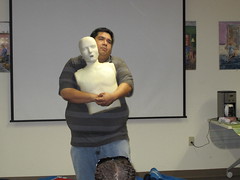
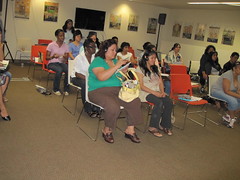
The MPC collaborated with Sinergia’s nursing staff, who were able to recruit a representative from the American Red Cross to conduct a CPR training for parents. Those who attended received first aid information, and they were taught how to perform Cardiopulmonary Resuscitation, or CPR, and help choking victims using the Heimlich maneuver. Mr. Antonio Chavez (above) from the Red Cross brought along a number life size dolls of children and adults that were used to practice CPR techniques. It was an intensive, interactive and exciting experience for the parents. They had to pass an on-site test in order to earn the CPR and First Aid certification, which is good for two years. Eighteen participants were able to obtain the certification, and these parents now possess skills that will help their loved ones in case of an emergency.

Would you know what to do if your child gets hurt or is in need of medical attention? Below are some ways that you can start getting prepared.

BASIC TIPS EVERYONE IN THE HOUSE SHOULD FOLLOW TO CREATE A SAFER HOME

1. DOES EVERYONE IN YOUR HOUSEHOLD INCLUDING YOUR HOME HELP AND CHILDREN KNOW YOUR ADDRESS AND NEAREST LANDMARK? Write your address and nearest landmark down on a wall both upstairs and downstairs in case you need to call for an ambulance. If you panic it’s easier to read off the paper.
2. DO YOU KEEP ALL YOUR FIRST AID ITEMS IN ONE LOCATION OR IN DIFFERENT DRAWERS THROUGHOUT THE HOUSE? If an accident happens its easier if  everything in one place.

3. DOES EVERYONE IN THE HOUSE KNOW WHERE THE FIRST AID KIT IS ? Ideally on a shelf out of reach or in a locked cupboard.

4. DO YOU HAVE A FIRST AID KIT IN THE CAR? Accidents can happen anywhere, at the beach, shopping mall etc. Make sure you have a back up first aid kit in the car.

5. DO YOU HAVE A LANDLINE IN ADDITION TO YOUR MOBILE? In an emergency you don’t want to be looking for your mobile only to find it’s out of battery or credit.

6. DO YOU AND YOUR HOME HELP KNOW WHERE THE NEAREST HOSPITAL IS FROM YOUR HOME AND THE QUICKEST ROUTE?

7. IF YOUR BABY OR CHILD CHOKES ON FOOD, FOR EXAMPLE A GRAPE, WOULD YOU KNOW HOW TO RESPOND?
Choking is every parent’s worst nightmare and so common amongst infants and young children. A first aid course will demonstrate the most effective way to remove an obstruction in the throat without causing further damage.

8. DOES EVERYONE IN THE HOUSE KNOW THE NUMBER TO CALL FOR AN AMBULANCE?
You would be surprised at the number of parents and home help that have never thought of it. Dial 999 for medical assistance.

9. DO YOU HAVE RULES IN THE HOUSE TO AVOID ACCIDENTS IN THE KITCHEN, BATHROOM etc.?
For example, pan handles should always be facing inwards on the stove, have a "no kids" zone in the kitchen while preparing food, remove knives and sharp utensils from kitchen surfaces immediately after use.

10. DO YOU KEEP YOUR MEDICAL DOCUMENTS IN A CENTRAL LOCATION THAT CAN BE EASILY REACHED SHOULD YOU HAVE TO GO QUICKLY TO THE HOSPITAL? Label a separate folder for everyone in the home and store all medical information in these files in one place so everyone knows where they are in case you have to take them quickly to the doctors or hospital.

WHEN TO GO FOR HELP

Your child needs to go to an emergency room if he or she has:
  • An injury that causes the child to lose consciousness
  • A deep laceration
  • A possible broken bone
  • A burn
  • An animal bite
  • Swallowed something toxic
  • Extreme difficulty breathing (for instance, because of an asthma attack or choking.
  • A convulsion
  • Vomited blood
  • Bleeding from the ear
  • A fall followed by a severe headache, persistent vomiting, weakness, or an
  • abrupt change in mental status (hallucinations, incoherence, irritability or
  • extreme lethargy) within 24 hours
  • A fall or head injury and the child is under 1
  • A fever and the child is under two months old
Courtesy of the American Red Cross and the American Heart Association. 

Friday, September 4, 2009

Tips For Staying Safe During Flu Season

Flu season will soon be upon us and we will need to be particularly careful due to the presence of the Swine Flu or H1N1 virus. The Swine Flu is now being called Novel H1N1 because it is a new flu virus that is causing illness in people. This new virus was first detected in people in the United States in April 2009. This virus is unique in that it is a combination of flu virus strains that have been observed in pigs, birds and humans. This virus is spreading from person-to-person through coughing or sneezing, probably in much the same way that regular seasonal influenza viruses spread. The World Health Organization is classifying the novel H1N1 flu as a “pandemic” because it is a new virus strain that has never infected people before and also is affecting people on a global scale, spreading from one continent to another.

Symptoms
The symptoms of novel H1N1 flu virus in people include fever (over 100 degrees), cough, sore throat, runny or stuffy nose, body aches, headache, chills and fatigue. A significant number of people who have been infected with this virus also have reported diarrhea and vomiting. Severe illnesses and death has occurred as a result of illness associated with this virus. The effects of novel H1N1 virus has ranged from mild to severe and most people who have become ill with this new virus have recovered without requiring medical treatment About 70 percent of people who have been hospitalized with novel H1N1 virus have had one or more medical conditions previously recognized as placing them at “high risk” of serious seasonal flu-related complications. This includes pregnancy, diabetes, heart disease, asthma and kidney disease. Interestingly, the information from the Center for Disease Control (CDC) shows that novel H1N1 flu has caused greater complications in people younger than 25 years of age than older people. At this time, there are few cases and few deaths reported in people older than 64 years old, which is unusual when compared with regulas seasonal flu. So far, novel H1N1 appears to have the affects of seasonal influenza and the feared deadly impact has not been apparent.

What To Do
People infected with seasonal and novel H1N1 are contagious, and may be able to infect others from 1 day before getting sick 5 to 7 days after. This can be longer in some people, especially children and people with weakened immune systems and people infected with the new H1N1 virus. A person with novel H1N1 illness should be excluded from school, work, and related activities and should not go into the community, except to seek medical care, until they are symptom-free (no fever without fever control medications and feels well) for at least 24 hours. In order to protect yourself and to stay healthy, you should do the following:

• Cover your nose and mouth with a tissue when you cough or sneeze. Throw the tissue in the trash after you use it.

• Wash your hands often with soap and water, especially after you cough or sneeze. Alcohol-based hands cleaners or hand sanitizers that contain at least 60% alcohol are also effective. Wash with soap and water with soap and warm water for 15 to 20 seconds (sing the “Happy Birthday” song twice).

• Avoid touching your eyes, nose or mouth. Germs spread that way.

• Stay home if you get sick and limit contact with others to keep from infecting them.

By Godfrey Rivera